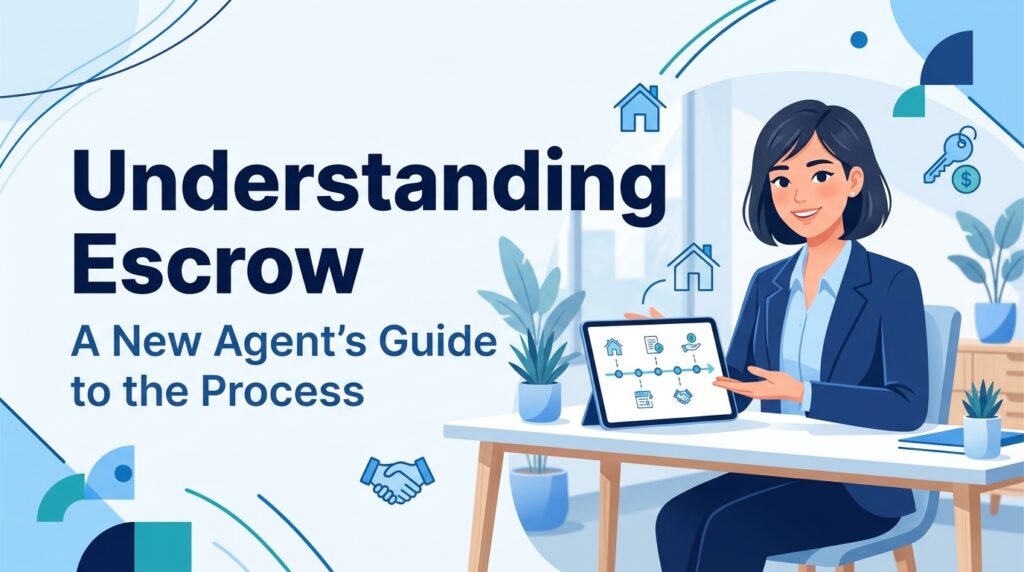
If you have been in real estate for any length of time, you have probably had a client look at you with that glazed-over expression when you said the word “escrow.” Maybe you explained it fine. Maybe you fumbled it a little. Either way, you are not alone. Most licensing courses teach agents the legal definition of escrow. They do not teach you how to explain it to a first-time buyer who is nervous about handing over several thousand dollars to someone they just met two weeks ago.
This post is for agents in Ocala, Belleview, Dunnellon, Silver Springs Shores, and the broader Marion County area who want a clear, practical framework for understanding escrow and communicating it to clients without turning a five-minute conversation into a forty-five-minute seminar.
Start With the Analogy, Not the Definition
Here is the version that works every time. Tell your client: escrow is a neutral holding room. Imagine two people agreeing to swap something valuable. One person hands their item to a neutral third party, and the other person does the same. That third party holds both items until every condition of the deal is verified, then releases them simultaneously. Neither side can back out and walk away with the other person’s property.
That is escrow. In a real estate transaction, the neutral third party is typically the title company. They hold the buyer’s funds and the seller’s deed until the contract conditions are met, and then everything transfers at the same moment.
Why does this matter to your client? Because without escrow, they would have to trust a complete stranger with either their money or their house. No reasonable person wants to do that. Escrow removes the trust requirement and replaces it with a legal process. When you explain it that way, clients stop looking confused and start nodding.
Florida Escrow Is Not the Same Everywhere
One thing that catches newer agents off guard is that escrow does not work identically in every state. If you are working with a buyer relocating from California, Arizona, or several other Western states, they may walk into the transaction expecting a completely different process.
In California, escrow officers and title companies often operate as separate entities with different roles. A buyer from that market may ask “who is the escrow company?” expecting a distinct company name, separate from whoever is handling the title search. In Florida, those functions are almost always handled by the same closing company. The title company manages the title search, holds the escrow funds, and handles the closing itself. It is a bundled process here.
This is worth one short conversation at the beginning of every transaction with a relocating buyer. Something like: “The closing process in Florida works a little differently than what you may have experienced before. Here is what to expect.” That one conversation prevents three panicked calls later in the transaction.
The Three Questions Your Clients Will Ask
There are three questions about escrow that come up in nearly every transaction. Know these cold and you will handle 90 percent of client concerns before they become problems.
What happens to my earnest money if the deal falls through? The short answer is: it depends on when and why the deal ended. If the buyer cancels within the inspection period for a valid reason, they generally get their money back. If they cancel after the inspection period without a contract-allowed reason, the seller may be entitled to keep it. The specifics are governed by the contract language. Your job as the agent is not to memorize every possible scenario. Your job is to make sure your clients understand the rules before they sign. Walk through that section of the contract with them early.
How long does escrow last? Escrow runs for the entire length of the contract — 30 days, 45 days, whatever was negotiated. Some buyers think escrow is a separate phase that happens before closing. It is not. Escrow is the transaction period. Closing is when escrow ends. That one clarification eliminates a lot of confusion about timelines.
Who do I call if I have a question about my money? The title company. Not the buyer’s agent. Not the seller’s agent. The title company is the escrow holder and the direct line for questions about funds, confirmation of receipt, and release of money. Make sure your clients have that contact number from day one.
A Quick Benchmark for Your Current Escrow Process
Whether you are working your first deal or your fiftieth, it is worth running this three-question check on whatever title relationship you currently have.
Question one: Does your title company confirm receipt of earnest money in writing, same day? They should. If it routinely takes two days to get that confirmation, that is a process gap.
Question two: Can your clients reach a real person when they have questions about their funds? If they are consistently getting routed to voicemail, that is a service issue that will erode client trust.
Question three: When something changes in the transaction, does the title company reach out to you proactively, or do you always have to chase them? Proactive communication is the baseline in a well-run closing operation, not a premium feature.
If those three questions are not getting yes answers consistently, that is worth a conversation.
The Bottom Line for Marion County Agents
Escrow is not a complicated concept when someone explains it clearly. The holding room analogy works. The regional context matters for out-of-state buyers. The three common client questions are predictable and answerable. And the three-question benchmark gives you a real way to evaluate whether your current process is working.
If you are an agent in Ocala, Belleview, Dunnellon, or anywhere in Central Florida and you want a title partner who communicates clearly, answers the phone, and handles the escrow process without making you chase down confirmations, reach out to True Title of Central Florida. We would be glad to walk through the process with you.
True Title of Central Florida — Serving Ocala, Belleview, Dunnellon, Silver Springs Shores, and Marion County