
How to Read a Title Commitment Without Getting Overwhelmed
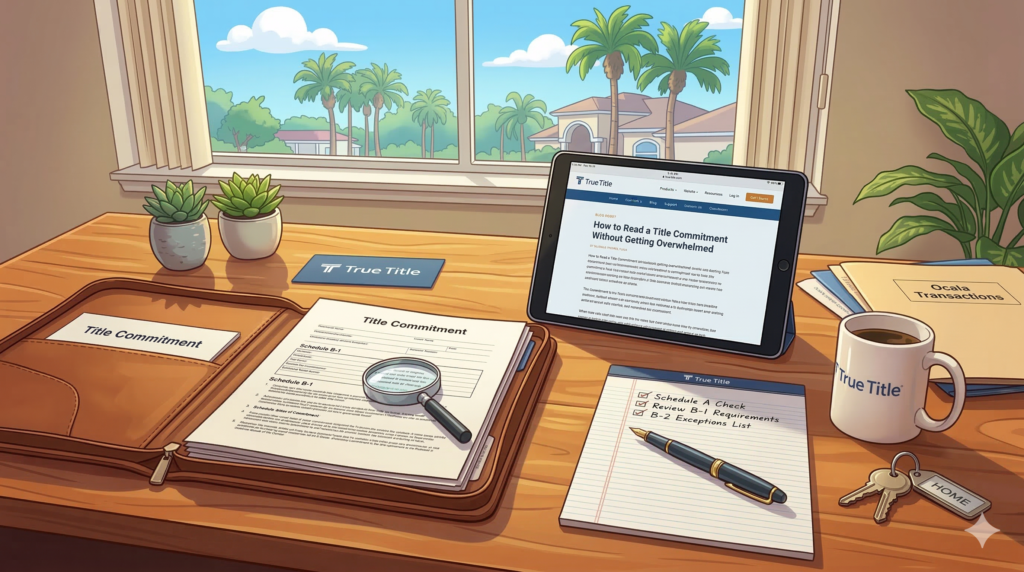
You have the contract signed. The inspection is behind you. The momentum is building toward a successful closing. Then, an email arrives with a thirty-page PDF attached: the Title Commitment.
For many ambitious newcomers in the real estate world, this document feels like a brick wall of legal jargon. It is easy to feel a surge of anxiety as you scroll through pages of property descriptions, exceptions, and requirements. You know your reputation is on the line, and the last thing you want is a surprise title defect popping up forty-eight hours before closing.
Here is the good news: you do not need to be a real estate attorney to master this. Reading a title commitment is about knowing where to look and what to prioritize. Think of it as a roadmap to a “No-Drama Closing”. Once you understand the structure, you can stop “checking in” on the status and start handling the transaction with the calm confidence of a seasoned pro.
The Schedule Strategy: Where to Focus First
A title commitment is essentially a promise. The title company is saying, “We will issue an insurance policy as long as you meet these specific conditions”. To keep from getting buried in the fine print, you need to break the document into its four core components: Schedules A, B-1, B-2, and the often-overlooked Requirement sections.
Schedule A: The “Who, What, and How Much”
Consider Schedule A your fact-checking station. This section provides the foundational data for the entire transaction. You should verify these details immediately upon receipt:
- The Effective Date: This tells you how recent the title search is.
- The Policy Amount: This must match the purchase price on your contract.
- The Proposed Insured: Ensure the buyer’s name is spelled exactly as it appears on their legal identification.
- The Legal Description: Does this match the survey and the address of the property you are selling?
Schedule B-1: The To-Do List
This is the most critical section for an agent. Schedule B-1 lists the requirements that must be satisfied before the title can be transferred. If Schedule A is the “what,” Schedule B-1 is the “how.” This is where you will find “the fix” for any potential drama.
Common requirements include:
- Payment of all property taxes.
- Recording of a new deed from the seller to the buyer.
- Satisfaction of existing mortgages or liens.
- Resolution of any municipal liens or unrecorded issues.
Schedule B-2: The “What We Aren’t Covering”
While B-1 tells you what to do, Schedule B-2 tells you what the title policy will not cover. These are called “exceptions”. These typically include standard items like utility easements or homeowners association (HOA) covenants that “run with the land.”
A Step-by-Step Guide for the Ambitious Newcomer
If you are feeling the pressure of a shifting market where inventory is up and timelines are stretching to seventy-five days, precision is your best defense. Use this step-by-step process to review every commitment like a partner, not a vendor.
1. Verify the Players and the Price
The moment the commitment hits your inbox, cross-reference Schedule A with your contract. In Marion County, where financed transactions dominate the $250,000 to $399,999 price band, lender requirements are strict. A misspelled name or an incorrect sales price can trigger a cascade of corrected documents that push back your closing date.
2. Hunt for “Cloudy” Issues in B-1
Look specifically for anything that requires action from a third party. Are there old permits from 2018 that were never closed out? Is there a requirement for an HOA estoppel letter? As your “Chief of Staff,” we aim to identify these “clouds” on title early. If you see something that looks complex, do not wait for the client to ask. Reach out to your escrow officer to confirm that the resolution is already in motion.
3. Check the Legal Description Against the Survey
This is a common pitfall for new agents. Does the legal description in the commitment match the survey provided by the buyer? In Central Florida, nuances in legal descriptions can lead to post-closing fines or legal disputes if not caught early. If there is a discrepancy, it needs to be flagged immediately.
4. Review the “Standard Exceptions” in B-2
Most B-2 exceptions are normal. However, you should look for anything unusual, such as an unexpected shared driveway agreement or a specific restriction that might interfere with the buyer’s intended use of the property. Helping your buyer understand these early builds the “Trust” that leads to long-term referrals.
Your Title Commitment Cheat Sheet
Keep this simple reference guide handy. It simplifies the 30-page legal document into the four questions that actually matter for your closing.
| Section | What it is | Your Move |
| Schedule A | The Facts | Verify names, price, and legal description match the contract. |
| Schedule B-1 | The Requirements | This is your “To-Do” list. Confirm that liens, taxes, and old permits are being handled. |
| Schedule B-2 | The Exceptions | Review what the insurance won’t cover (easements, HOA rules). Ensure there are no “deal-breakers”. |
| Legal Description | The Map | Ensure the land described is the exact land your buyer thinks they are getting. |
Proactive Ownership: The Key to Reputation Shielding
In Ocala and Marion County, your reputation is your most valuable asset. High-volume agents succeed because they provide “Operational Certainty” to their clients. They don’t just pass along a document; they interpret it, manage the risks, and remove obstacles before they become issues.
When you receive a commitment, don’t just file it away. Take ten minutes to run through the steps above. If you see a problem, remember that “everything is figureoutable”. We don’t find fault; we solve problems. By the time your client or the lender asks about a potential delay, you should already be able to say, “The records showed a minor issue, but we have already engineered the solution”.
That is the difference between an agent who is “trying to fix” a deal and one who is “handling” a transaction.
Are you currently working through a complex title commitment and have a question about a specific requirement? Let’s get the conversation started in the comments below, or reach out to our team for a “No-Drama” clarification on your file.