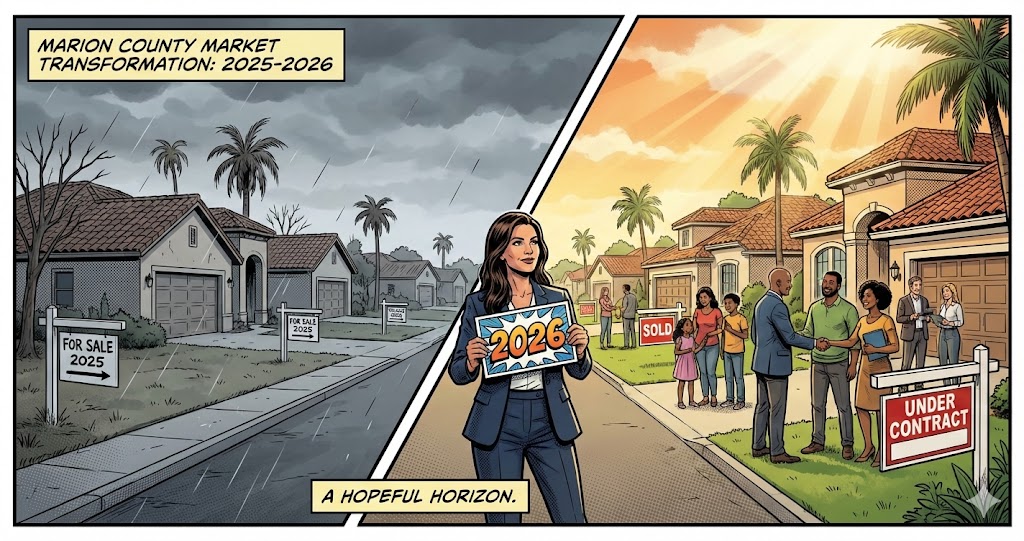
After one of the most challenging years in real estate in nearly five decades, the Marion County market is positioned for meaningful recovery in 2026. The question isn’t whether conditions will improve, but how quickly, and what that means for agents preparing to capture opportunity in the year ahead.
Why 2026 Will Be Different
The 2025 market was defined by hesitation. Buyers waited for lower rates that never materialized. Sellers postponed listings hoping for appreciation that didn’t arrive. The result was a standoff: 6,503 closed sales through September, down 4.3% year-over-year, with inventory climbing 30.6% to 4,128 active listings and median days on market stretching to 94 days.
But markets don’t remain frozen indefinitely. By late 2025, both buyers and sellers began accepting the current environment as the new baseline rather than a temporary anomaly. That psychological shift, combined with improving fundamentals, sets the stage for 2026 to reverse the trends that defined the past two years.
The Affordability Equation Is Improving
Affordability drives transaction volume more than any other single factor. When buyers can qualify for the home they want at a monthly payment they can manage, deals happen. When they can’t, the market stalls.
Three variables determine affordability: home prices, mortgage rates, and household income. In 2026, all three are moving in the right direction.
Home prices have stabilized. The Marion County median sale price held relatively flat in 2025 at $289,990, representing just a 0.3% year-over-year increase. In September, the median actually declined 1.7% compared to the prior year. This is not a collapse. It’s a normalization that restores negotiating power to buyers and removes the psychological barrier of chasing an ever-rising target.
Mortgage rates are expected to stabilize in the mid-6% range. While we won’t see a return to the sub-4% rates of 2020-2021, the market has adapted to the current rate environment. Buyers who have been waiting for 3% rates are increasingly recognizing that delaying homeownership indefinitely is more costly than purchasing at today’s rates and refinancing later if conditions improve.
Household purchasing power is set to increase. Federal tax policy changes currently under legislative consideration would increase take-home pay for middle-income earners. While the final details are still being finalized, the intent is clear: to stimulate consumer spending and investment, including home purchases. If enacted, these provisions will provide qualified buyers with additional monthly cash flow, directly translating into higher purchasing power and increased transaction volume.
The combined effect of stable prices, predictable rates, and improved income creates the conditions for pent-up buyer demand to re-enter the market.
Pent-Up Demand Is Real
The buyers who have been sitting on the sidelines for two years haven’t disappeared. They’ve been waiting. And waiting has a cost.
Renters have continued paying rent with no equity accumulation. Young families have delayed moving into larger homes. First-time buyers have watched their savings grow but their purchasing power remain flat. At some point, the cost of waiting exceeds the cost of buying in less-than-ideal conditions.
That tipping point is approaching in 2026. The psychological shift from “waiting for perfect conditions” to “accepting current reality and moving forward” will drive transaction volume higher, particularly in the first and second quarters as spring buying season coincides with renewed confidence.
Where Opportunity Will Concentrate
Not all segments of the Marion County market will recover at the same pace. The greatest opportunity in 2026 will be concentrated in the $250,000 to $400,000 price range.
This segment represented the highest concentration of both inventory and closed sales in 2025. It attracts first-time buyers utilizing FHA and VA financing, as well as move-up buyers trading equity from starter homes. It’s the price band where marginal improvements in affordability have the most significant impact on buyer qualification and decision-making.
Properties priced below $250,000 face limited inventory and high competition. Properties above $400,000 remain rate-sensitive and appeal to a smaller pool of qualified buyers. The middle market is where volume happens.
Agents who specialize in this segment, understand the financing nuances, and can navigate the title and closing requirements of these transactions will capture disproportionate market share in 2026.
The Early Movers Will Win
Markets don’t turn on a specific date. They shift gradually as early adopters recognize opportunity before the majority.
In early 2026, while many agents are still waiting for “better conditions” or “clearer signals,” the top producers will already be actively listing properties, writing contracts, and closing deals. They’ll build momentum in Q1, establish themselves as the dominant local voices by Q2, and dominate market share when buyer activity accelerates in spring and summer.
The agents who wait for perfect conditions will miss the best inventory, the most motivated buyers, and the opportunity to establish market authority before competition intensifies.
What About the Risks?
No forecast is without uncertainty. Several variables could slow or accelerate the recovery timeline.
Interest rate volatility. If mortgage rates spike unexpectedly due to inflation concerns or Federal Reserve policy changes, buyer qualification and confidence could deteriorate rapidly. Conversely, if rates drop faster than expected, demand could surge beyond supply, creating a brief seller’s market in high-demand price ranges.
National economic conditions. A recession, significant job losses, or declining consumer confidence would override local market fundamentals and suppress transaction volume regardless of pricing or rates.
Regulatory and legislative changes. The proposed tax provisions that would increase household purchasing power are not yet law. If legislative priorities shift or the provisions are modified significantly, the anticipated boost to buyer demand may not materialize as quickly or as robustly as projected.
Local inventory dynamics. If sellers continue to delay listings, inventory constraints could prevent demand from converting into closed sales, resulting in price pressure without corresponding volume increases.
These risks are real, but they are not the most likely scenario. The baseline expectation, based on current fundamentals and historical patterns, is for gradual, sustained improvement throughout 2026.
The Fraud Threat Remains Elevated
One challenge that will not improve in 2026 is the escalating sophistication of fraud targeting real estate transactions.
Seller impersonation fraud and wire fraud attempts surged in 2025, and criminals are becoming more adept at exploiting transaction vulnerabilities. We encountered multiple instances of forged identities, fabricated documentation, and spoofed email communications designed to intercept earnest money deposits and closing funds.
In response, True Title implemented state-of-the-art fraud prevention controls: enhanced identity verification protocols, mandatory verbal confirmation of all wiring instructions via pre-established phone numbers, real-time client education on fraud red flags, and upgraded cybersecurity infrastructure.
These measures are not optional. They are the operational standard required to protect your clients and your reputation. Every agent must treat fraud prevention as a core component of client service in 2026, not as an administrative afterthought.
How to Position Yourself for Success
The agents who will thrive in 2026 are those who recognize that operational excellence, not market timing, determines success in a recovering market.
Get active early. List properties in Q1. Write contracts in January and February. Build momentum before competition intensifies. The market doesn’t reward those who wait for perfect conditions; it rewards those who execute competently in imperfect ones.
Educate your clients on realistic expectations. The 90-105 day listing-to-close cycle is the current baseline. Contracts written with 30-day closing deadlines create preventable complications. Buyers expecting pre-2022 appreciation rates will be disappointed. Setting accurate expectations from the start builds trust and prevents deal collapse.
Prioritize fraud prevention. Educate every client on wire fraud risks from the moment they sign a contract. Never communicate wiring instructions via email. Always verify account details via a known phone number. One prevented fraud is worth more than a hundred closed transactions.
Build strategic partnerships. Your lender and title company are not vendors; they are the operational infrastructure that determines whether your deals close on time, without surprises, and with the professional client experience that generates referrals. Select partners based on responsiveness, local expertise, and proven ability to resolve complex issues, not on promotional gifts or superficial relationships.
Invest in professional development. Market shifts require updated knowledge. Understanding new fraud prevention protocols, the implications of extended timelines on contract contingencies, and the strategic use of title commitments as due diligence tools will separate competent agents from exceptional ones.
The Bottom Line
The Marion County market is poised for a stronger 2026. Not because of speculation or wishful thinking, but because the structural fundamentals (inventory levels, pricing stability, improving affordability, and pent-up demand) are aligning with favorable economic conditions and potential regulatory tailwinds.
We’re coming off one of the worst real estate years in half a century. The only direction from here is up. The question is not whether the market will improve, but whether you’ll be positioned to capture the opportunity when it does.
From our position at the closing table, we see the difference between deals that succeed and deals that fail. It’s rarely the property or the price. It’s the quality of the professionals executing the transaction.
The agents who treat title work as a strategic advantage, prioritize client protection, communicate proactively, and understand that operational excellence is the only sustainable competitive differentiator will dominate in 2026.
We’ve handled the complexity of hundreds of Marion County closings. We know what works. And we’re here to ensure your 2026 transactions close on time, without drama, and with the professional certainty your reputation demands.
Let’s make 2026 your best year yet.